

.svg)

EN/ES
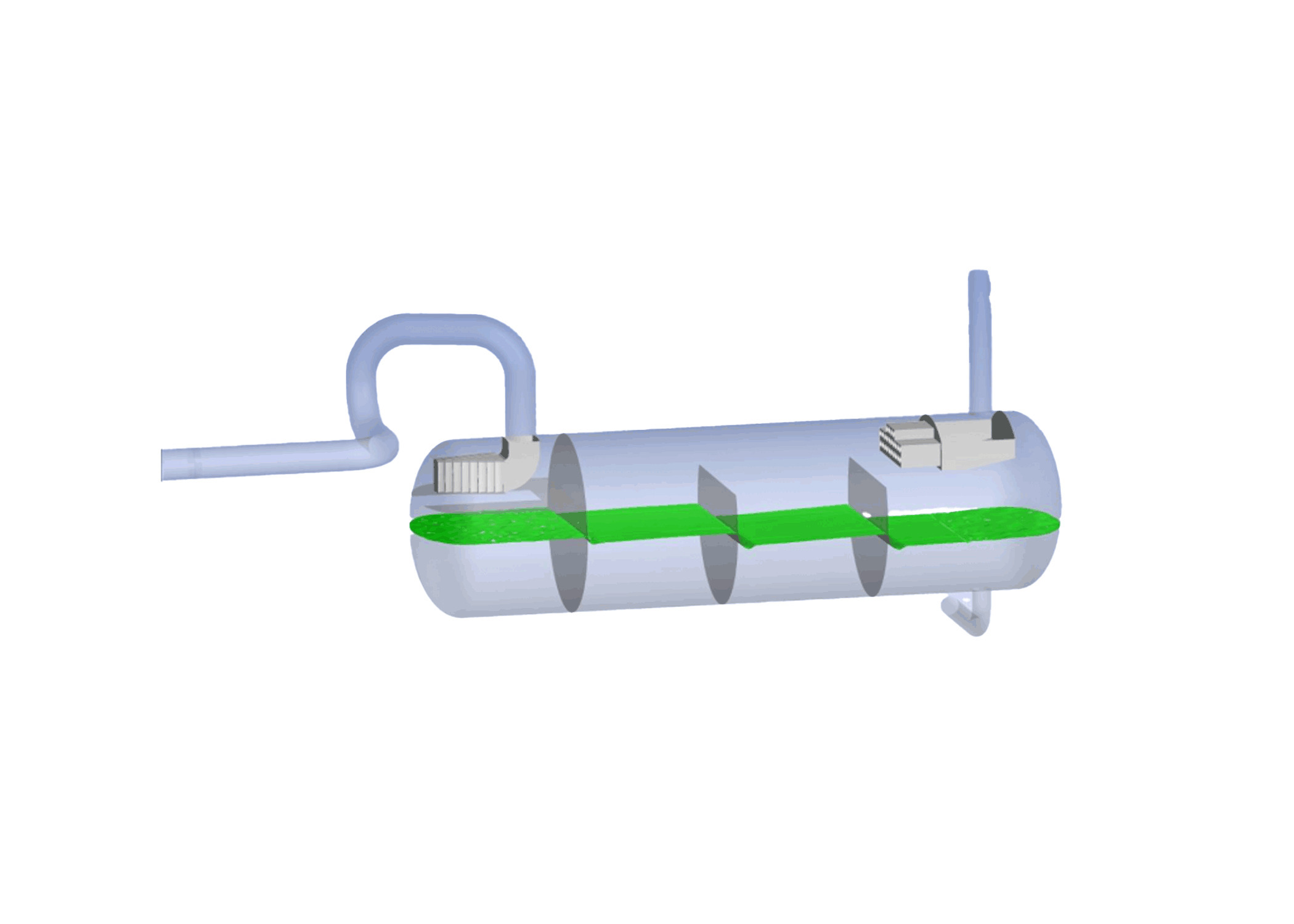
Motion baffles are perforated internals installed inside separators on FPSOs, floating production systems, semisubmersibles, and offshore platforms subject to vessel motion. Platform movement in pitch, roll, surge, sway, and heave creates sloshing that destabilizes the vapor-liquid interface, increases liquid loading on the demisting device, and causes carryover as liquid level rises on one side. Motion baffles compartmentalize the liquid section, restricting liquid movement per motion cycle and maintaining interface stability under dynamic conditions. Open area, hole size, baffle count, and spacing are engineered per vessel using CFD analysis to confirm performance across the platform's expected motion envelope. TrayTec supplies and installs motion baffles to your vessel geometry and offshore platform specification.
Mitigate motion affects in separator
Minimizes instability of interface level
CFD is used to optimize location
For more information please visit our Contact page

Platform motion in pitch and roll causes three specific degradation mechanisms inside a horizontal separator. First, liquid sloshing creates an unstable vapor-liquid interface that disrupts liquid-liquid separation and prevents the settled phases from maintaining a consistent level. Second, the rising liquid level on one side of the vessel increases the liquid load on the demisting device above it, which can exceed the device's drainage capacity and cause liquid carryover into the gas outlet. Third, the drainage head at the mist eliminator may become insufficient as liquid accumulates on one side, further compounding carryover. Motion baffles address all three by dividing the liquid section into compartments that limit the volume of liquid that can migrate with each motion cycle, stabilizing the interface and equalizing the liquid level across the vessel.
CFD analysis models the liquid movement inside the separator under the vessel's design motion conditions, including pitch amplitude, roll amplitude, and the frequency of each motion mode. The simulation identifies zones of high liquid velocity, interface disturbance, and potential carryover risk under the worst-case motion scenario. Baffle geometry, open area, and positioning are then optimized within the CFD model to confirm that interface stability and demisting device liquid loading remain within acceptable limits across the full motion envelope. Contact TrayTec with your vessel drawing and platform motion data to initiate a motion baffle design assessment.
A standard distribution baffle is designed primarily to dissipate inlet turbulence and distribute liquid uniformly across the vessel cross-section in a stationary vessel. A motion baffle is designed to resist liquid sloshing caused by dynamic platform motion and may use lower open area and a different baffle count and spacing to achieve the required compartmentalization under motion loading. In many offshore separator designs, the same perforated baffle serves both functions simultaneously, with the open area and positioning optimized to address both inlet turbulence and platform motion effects in the same vessel. Contact TrayTec to confirm whether a combined or dedicated motion baffle configuration is appropriate for your vessel and platform.
