

.svg)

EN/ES
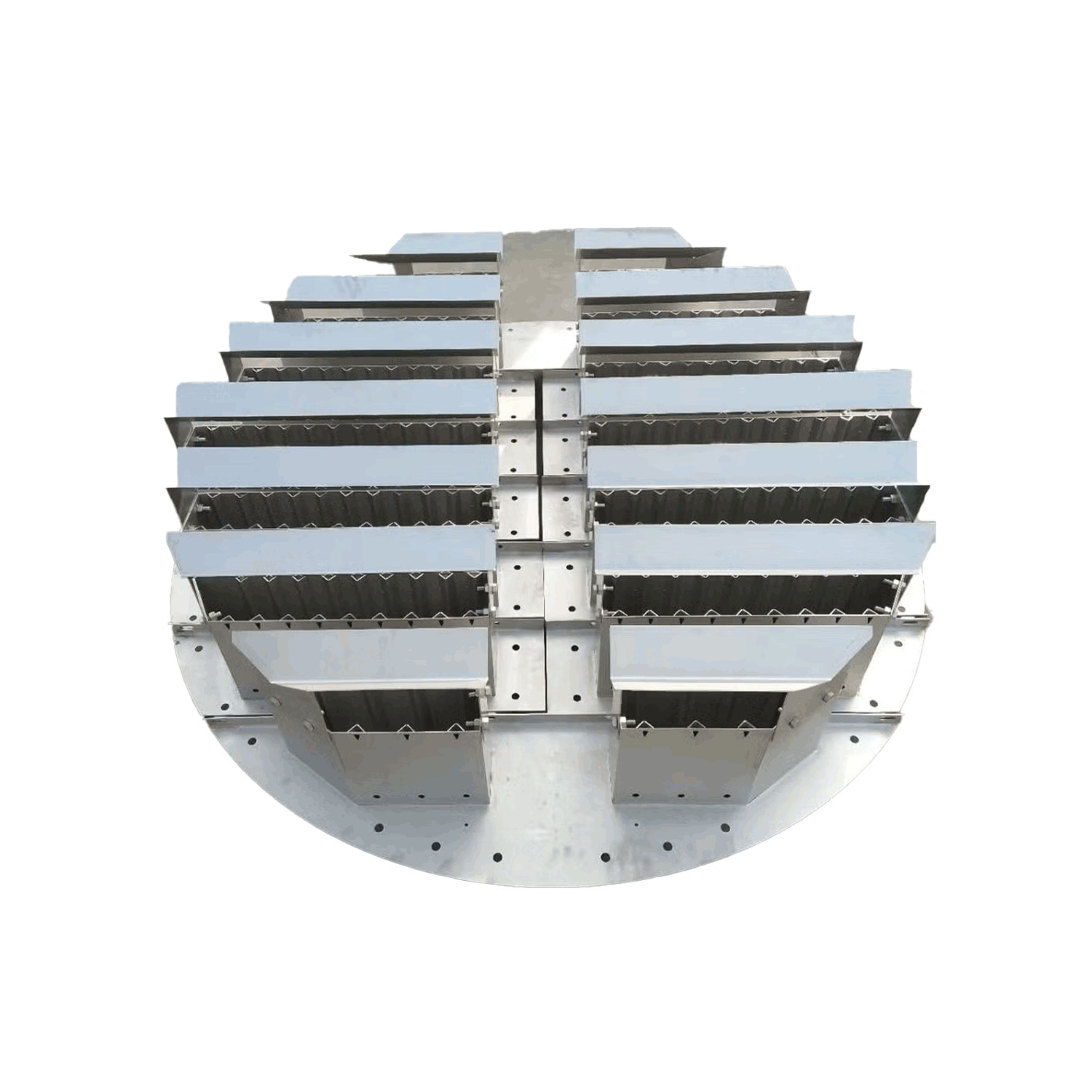
Transition trays serve as the mechanical interface between tray and packed bed sections within the same distillation column. They collect liquid from the active tray deck above and redistribute it uniformly across the full cross-section of the packing below, preventing maldistribution that would otherwise degrade separation efficiency across the entire packed bed.
TrayTec supplies chimney trays, lamella collectors, and gallery trays for two-phase feed service. Configuration is selected based on liquid rate, vapor load, column diameter, and the specific packing geometry and support arrangement below. Installation is performed to vendor drawing tolerances, with levelness and downcomer clearance verified at each deck before the bed is loaded.
For more information please visit our Contact page

A transition tray is specified when the column operates both tray and packed bed sections in the same shell and requires a structural deck that simultaneously collects liquid from the tray above, provides vapor rise area, and redistributes liquid uniformly onto the packing below. Standard collector trays handle liquid collection only and are not designed to manage the vapor-liquid traffic of an active tray section above them.
A chimney tray uses open risers to pass vapor upward while collecting liquid across the deck for redistribution — it is the standard configuration for most packed bed interfaces. A lamella collector uses inclined plate geometry to separate entrained liquid from the vapor stream before redistribution, and is specified where the vapor entering the packed bed carries significant liquid load that a chimney tray alone cannot adequately separate.
Gallery trays are transition tray configurations designed specifically for two-phase feed inlets where the incoming stream contains both vapor and liquid at significant rates. The gallery geometry provides controlled separation of the two phases at the feed point, directing vapor upward into the tray section and liquid downward onto the packed bed without creating the turbulence and maldistribution that a standard feed nozzle would produce at high two-phase velocities.
